"I have invested for five years and hope to reach a profit balance point next year." Chloe Wang, director and general manager of Hefei Heforging Intelligent Manufacturing Co., Ltd., said in an interview with CBN.
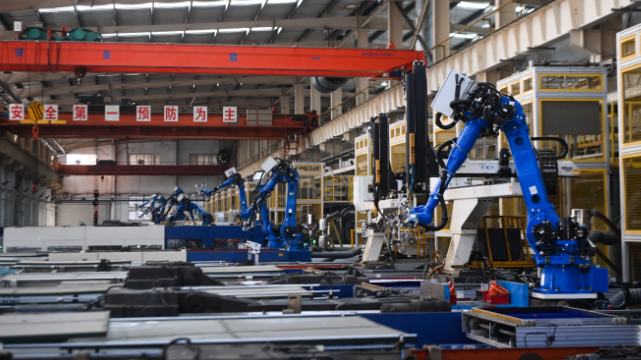
As an equipment manufacturing enterprise founded in 1951, Heforging Intelligent has been digitally upgraded based on the industrial Internet platform since 2017. "Digital transformation can improve production efficiency, but the premise is that it needs to be continuously ‘ Burning money ’ This is undoubtedly a huge sum of money for equipment manufacturing enterprises that originally invested heavily in assets. From ‘ Digital upgrade ’ Judging from the return on investment of the project, we have not made any profit in the past few years. Ideally, it will still take 2 to 3 years of layout and become a new profit growth point. " Chloe Wang said.
This is not only an individual story that happened in a traditional manufacturing enterprise, but also a microcosm of the digital transformation of domestic manufacturing enterprises in recent years.
China’s manufacturing industry has been ranked first in the world for many years, but the overall level of informatization is still not high, and the integration with industrialization is not deep enough. The digitalization of manufacturing enterprises, especially small and medium-sized manufacturing enterprises, is still in its early stage. At the beginning of November, the General Office of the Ministry of Industry and Information Technology issued the Notice on Printing and Distributing the Guidelines for the Digital Transformation of Small and Medium-sized Enterprises, proposing the idea of "from easy to difficult, from point to surface, long-term iteration and multi-party collaboration" for small and medium-sized enterprises, and proposing "promoting business collaboration, resource integration and data sharing of upstream and downstream enterprises in the industrial chain supply chain to help small and medium-sized enterprises realize ‘ Chain ’ Transformation "requirements.
The "small and medium-sized enterprises" here are interpreted by the Information Technology Development Department of the Ministry of Industry and Information Technology, especially the manufacturing small and medium-sized enterprises.
According to a recent survey released by iResearch, the digital transformation of manufacturing enterprises in China is still dominated by central state-owned enterprises and large-scale private enterprises, and the demand amount is concentrated between 1 million and 5 million. The overall project cycle lasts about 4 to 18 months, which has the characteristics of high amount and long duration.
Under the tug-of-war of multiple factors such as "demand vs cost vs effect", many people in the industry interviewed told reporters that for small and medium-sized manufacturing enterprises, especially those in traditional heavy asset industries such as equipment manufacturing, how to achieve sustainability in digital transformation is still a difficult problem to be solved.
Is digitalization a "compulsory course"
"Digitalization is not an end." Chloe Wang said that the digital transformation of manufacturing industry in an ideal state is a means to reduce costs, increase efficiency and expand new business models.
He believes that the transformation includes two aspects: one is the digital transformation of the whole cycle from production to sales within the enterprise, and the other is to enhance the value of the data loaded by the product. The former aims to improve quality and efficiency, while the latter aims to increase the market competitiveness and customer stickiness of products by optimizing the sense of product use, and finally help enterprises realize the transformation from island type to user experience type.
"For industry enterprises, it is still a question mark whether digital investment is just needed and to what extent digitalization can bring the greatest value to enterprises. If the transformation is carried out, SMEs will also face a problem: as the head enterprises have implemented the full-cycle digital integration innovation with the help of information means such as industrial Internet and big data platform, if they continue to rely on the digital transformation of a single link, the marginal utility of SMEs to obtain digital dividends will be weakened. " Chloe Wang said.
Multiple factors are superimposed, is the motivation for the transformation of SMEs sufficient? This problem once troubled Zhang Youming, general manager of UFIDA Jingzhi Industrial Internet Division. However, after attending the training activities of the digital transformation of small and medium-sized entrepreneurs in the Industrial Culture Center of the Ministry of Industry and Information Technology as a lecturer, he had a more positive answer to this question: "Within one week after the meeting, many students contacted me actively, and some of them later became our customers. Many of these students were at the helm of small and medium-sized equipment manufacturing enterprises."
Zhang Youming told CBN that the informatization foundation of such enterprises has been weak. "The automobile and process manufacturing industries have high requirements for refined management level and automation level of key machines needed for continuous production, so the digital progress of the industry can be promoted quickly."
In contrast, the equipment manufacturing industry has "walked slowly" in the digital transformation. Zhang Youming believes that this is caused by multiple factors. First, as an industry with heavy investment in assets, if the equipment manufacturing industry iterates intelligent products for large equipment in the production process, the transformation cost will be even higher; Secondly, as a traditional manufacturing industry, the equipment manufacturing industry is relatively extensive, with low profit margin, and the motivation of small and medium-sized enterprises to apply new technologies is limited. In addition, the supply chain and industrial chain of the equipment manufacturing industry have been relatively fixed, and the space for business expansion is relatively limited after enterprises "go to the cloud".
"Positive factors are increasing." Zhang Youming believes that at present, with the upgrading of downstream demand, the strength of customized production capacity has directly affected the competitiveness of equipment manufacturing enterprises, and this mode of collaborative management while designing and producing is difficult, making digitalization gradually become an urgent need for enterprises.
"Complex products and many spare parts are the industry characteristics of the equipment manufacturing industry, and small and medium-sized enterprises are no exception. With the increase of upstream parts manufacturers in the industry, whether we can find suppliers with better cost performance and whether the supply channels are smooth is directly related to the production and sales of enterprises. To solve the synergy problem of this kind of all-factor industrial chain, it is necessary to build an industrial Internet platform. " Zhang Youming said.
According to Zhang Youming, the industrial Internet can help small and medium-sized enterprises get through the upstream and downstream of the supply chain, reduce their raw material costs, and increase their ability to seize business opportunities and market bargaining power by receiving more downstream customers. In addition, after enterprises go to the cloud platform, production, R&D and sales are all digital. This way of "converting traditional assets into industrial data and then converting data into credit" also provides a solution to the financing problem of SMEs.
Integrate into digital ecology
"I have contacted many small and medium-sized manufacturing enterprises, and almost no business decision makers don’t know about the industrial Internet, but few can really tell what the industrial Internet architecture is? What are the business software of enterprise operation management adapted to the big data ecological environment? What business does the enterprise need ‘ Shangyun ’ ?” A person in charge of business related to enterprise cloud services and software providers told reporters.
At the beginning of November, the Ministry of Industry and Information Technology issued the Evaluation Table of Digitalization Level of Manufacturing SMEs (2022 Edition). On the index of "Digitalization Basis", 20% of the weight is "Enterprises realize digital management of business by deploying industrial Internet public cloud/private cloud/hybrid cloud platform".
Daniel He, co-founder and CEO of Shugen Internet, told CBN that "Industrial Internet" has many extensions, including automatic equipment sensors, 5G communication solutions and many industrial solutions, but its real core is these operating systems or industrial Internet platforms. "With the head manufacturing enterprises taking the initiative to build an industry-level industrial Internet platform, it is convenient for SMEs to catch up with the digital transformation of the industry."
It is also mentioned in the Guide to Digital Transformation of Small and Medium-sized Enterprises that small and medium-sized enterprises should integrate into the digital ecology. Apply the industrial internet platform built by the core enterprises in the industrial chain and supply chain, integrate into the core enterprise ecosystem, strengthen cooperation and support, and realize the coordinated transformation of large, medium and small enterprises. Apply the common solutions exported by leading enterprises in the industry to accelerate the improvement of their digital level.
According to the guide, in addition to the leading enterprises in the industry, the service providers of digital transformation of small and medium-sized enterprises also include Internet platform enterprises, industrial Internet platform enterprises and digital transformation service providers.
According to the data of the Ministry of Industry and Information Technology, as of the third quarter of 2022, the industrial Internet has been fully integrated into 45 categories of national economy, and more than 150 characteristic platforms with certain industry and regional influence have been cultivated, and 28 cross-industry and cross-domain industrial Internet platforms have been selected, among which 32 key platforms have more than 79 million sets of connecting equipment and more than 280,000 industrial apps.
Faced with more and more regional, industry and enterprise industrial Internet platforms, the choice and bargaining power of small and medium-sized manufacturing enterprises in digital investment began to increase. However, new problems follow: how can SMEs "get on the platform" with lower threshold and lower cost?
"There are three main concerns of SMEs: first, applications that can generate value, second, affordable, and third, low barriers, that is, not many IT engineers know how to use them." Daniel He said that on the supply side, in view of the characteristics and actual needs of small and medium-sized enterprises, digital transformation service providers have begun to provide lightweight and subscription services to alleviate the concerns and costs of digital transformation of small and medium-sized enterprises.
The so-called "subscription service", Daniel He said, is to deposit all kinds of industrial best practices on this industrial Internet platform, and then let SMEs directly subscribe to these industrial application apps.
According to Zhang Youming’s observation, the choices of small and medium-sized enterprises are often diversified. They can choose to share the platform with chain-length enterprises, or they can choose to rent, buy the industrial Internet platform built by third-party cloud service providers in one time or in stages.
Daniel He believes that the industrial Internet is a huge ecology and system. From the perspective of input cost and time, even small and medium-sized manufacturing enterprises with abundant cash flow need to carefully consider building their own industrial Internet platform.
"If every enterprise does its own common platform at the bottom, on the one hand, it will spend a lot of money, spend a lot of time and need a lot of talents; On the other hand, in terms of application scale, it is actually amortization for enterprises. " Daniel He said.
Two Challenges of Sustainable Transformation
Traditional manufacturing enterprises are forced to digitize, and the rising labor cost is one of the major reasons. However, some interviewees told reporters that after the transformation, the employment cost of some small and medium-sized manufacturing enterprises has increased instead of falling.
"The rising labor costs in manufacturing really reflect the shortage of talents." Daniel He said.
Zhang Youming said that on the one hand, the industrial Internet needs compound talents who know both industry and digital technology, and are also very innovative. This kind of talent training cycle is very long. The Ministry of Education added the major of industrial Internet application in 2021, that is to say, before that, the social supply of industrial Internet talents could only be cultivated by enterprises; On the other hand, if a manufacturing enterprise does not set up a science and technology company, it will not be able to recruit and retain digital talents according to its original salary system, and even cultivate the digital team of the enterprise, but this will undoubtedly not work for small and medium-sized manufacturing enterprises in the short term.
In response to the challenge of insufficient information professionals’ reserve, the strategy adopted by Hezhengzhizao is to invite "foreign aid". Chloe Wang said that up to now, the technology companies that the company has cooperated or invested abroad include Iflytek and Anhui Sanheyi Information Technology Co., Ltd..
In the long run, there are two ways to solve the talent gap problem in the digital transformation of manufacturing industry. Sunny Li, the Industrial Internet Research Office of CCID Research Institute, told CBN that on the one hand, it is necessary to give full play to the role of industry alliances and organizations as a bridge, and focus on technical shortcomings such as hardware foundation, industrial software, data transmission, and industrial control security in order to meet the needs of manufacturing applications. Jointly tackle a number of common key technologies; On the other hand, IT is necessary to deepen the cooperation between production and education, establish a joint training mechanism of "enterprise+university", and directionally transport a group of compound talents who know both IT and OT to the manufacturing industry.
Not only is there a shortage of people, Chloe Wang said that data is the key value of intelligent manufacturing products. However, at present, the downstream customers’ recognition and utilization rate of digital application of products are not high, the added value of products is difficult to show, and the R&D investment of manufacturing enterprises cannot form positive feedback, which also makes some small and medium-sized manufacturing enterprises lose the motivation of transformation.
Just like the downstream customers of aerospace and military industries have high requirements for the digital application of high-end intelligent manufacturing, in practice, Chloe Wang found that the needs of these customers have little benefit for intelligent manufacturing enterprises. "At present, downstream industries with high demand for digital applications of products are often industries with higher demand for data security and privacy protection. This has led to the need for manufacturing companies to sign confidentiality agreements when serving customers in such industries, and to share data point to point, making it difficult to maximize the value of data. "
Chloe Wang appealed that if the digital transformation of manufacturing enterprises is sustainable, it is necessary to build a more mature data factor market, so as to promote manufacturing enterprises to rebuild their competitive advantages through digital transformation.