The Creation Background of Mao Zedong’s "Spring and Snow in the Qinyuan"
Publication process, political influence and cultural connotation
(I)
Hupingyuan
During the negotiations in Chongqing in 1945, Mr. Liu Yazi asked President Mao Zedong for poems, but it was difficult to plead. Mao Zedong wrote the book "Spring and Snow in Qinyuan" and gave it to Liu Yazi. After several copies, it was published in Chongqing Xinmin Daily Evening Magazine, which caused a sensation in the mountain city and was recited by ten thousand people. After the founding of People’s Republic of China (PRC), it was officially published in the inaugural issue of Poetry Magazine in 1957. Only two copies of the calligraphy of this word are Chairman Mao’s handwriting, which is very precious. As far as Ci is concerned, its political influence, cultural connotation and the value of calligraphy art are truly unprecedented and priceless.
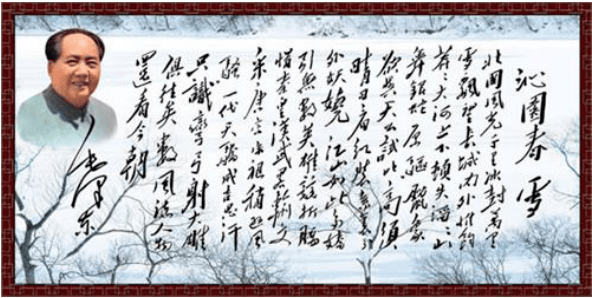
Mao Zedong’s Qin Yuan Chun Xue
one
Political influence
Mao Zedong’s poems are an important part of Mao Zedong Thought. What is Mao Zedong Thought? General Secretary of the Supreme Leader said: "Mao Zedong Thought’s living soul has three basic aspects, which are seeking truth from facts, the mass line and independence." This thought is the truth of the great victory of China Revolution. So how far-reaching political influence and historical significance does "Qin Yuan Chun Xue" have? How was it presented to Mr. Liu Yazi? How was it published in Chongqing? The author carefully studies the humanities and sorts out textual research for readers.
On August 30, 1945, during the negotiations in Chongqing, Mao Zedong invited old friends to get together in Guiyuan apartment in Chongqing and hosted a banquet for Liu Yazi, Shen Junru and others. Liu Yazi organized Nanshe in his early years, followed Dr. Sun Yat-sen to participate in the Revolution of 1911, and worked with Mao Zedong during the Great Revolution. Because they both love classical poetry, they are more cordial than ordinary friends. During the banquet, Liu Yazi presented a poem of Mao Zedong’s Seven Rhymes, which said, "After leaving Yangcheng in the 19th autumn, meet again and shake hands to celebrate Yuzhou. The sky is brave and honest, and the people are chaotic everywhere. Lin Yu gave birth to the new country, and Yun Lei made history in the same boat. Zhongshan Carl Shuang Yuan joined together and smiled at Kunlun. " On September 2nd, Xinhua Daily published this poem with the title of "To Mao Runzhi’s Old Friends".
On September 6th, accompanied by Zhou Enlai and Wang Ruofei, Mao Zedong visited Liu Yazi in Jinnan Village of Nankai School in Shapingba, Chongqing. In Mr. Liu’s apartment, Liu Yazi asked Mao Zedong for poems. Therefore, Mao Zedong presented "Spring and Snow in Qinyuan" to Liu Yazi with a simple sentence: "When I first arrived in northern Shaanxi and saw the heavy snow, I filled in a word, which seemed to be slightly close to my husband’s poem, and recorded it for correction."
After Mr. Liu Yazi got the "Qin Yuan Chun Xue" inscribed by Chairman Mao, he regarded it as a treasure, that is, the poem "Qin Yuan Chun Er Yun and Mao Runzhi’s snow-singing work" was not entirely in accordance with the original meaning. Attach the original word: "Twenty years of reunion, a new word, meaning floating in the clouds." Sighing the stagnation of green plum wine, I am embarrassed; The Yellow River is turbid and surging all over the world. Adjacent to DiShanyang, Boren is up to me, and it is difficult to draw a sword to level the base. Very sad, crying unparalleled guoshi, peerless enchanting. Talent, faith and beauty are so charming. Look at the poets of the ages. Calculate Huangzhou satrap, still lose spirit; Jiaxuan lay man only solves complaints. Laughing more, Hu Er, Nalan Rong Ruo, and Yan Xiang carved with emotion. Jun and I want to go to heaven and land and seize the present. "
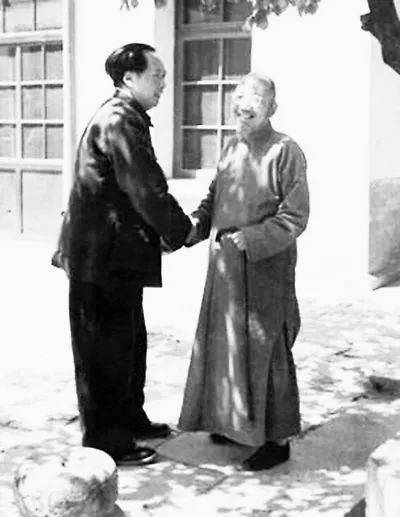
In May 1949, President Mao Zedong met with Mr. Liu Yazi at Shuangqing Villa in Xiangshan, Beijing (Source: Beijing Daily).
After Mao Zedong returned to Yan ‘an after the negotiations in Chongqing, Liu Yazi personally sent Mao Zedong’s "Qinyuan Spring Snow" and his poems to Xinhua Daily for publication. But the editor-in-chief of the newspaper told him that publishing Mao Zedong’s works (including poems) should ask Yan ‘an for instructions and get Mao Zedong’s consent. After consultation between the two sides, Mao Zedong’s "Qinyuan Spring Snow" will not be published for the time being, and only Mr. Liu Yazi’s harmony words will be published in the supplement of Xinhua Daily on November 11th of the same year. Because when Mr. Liu Yazi and Ci were published in Xinhua Daily, the title was Qinyuanchun, and the subtitle was "Secondary Rhyme and Mao Runzhi’s Poems on Snow, which were not in accordance with the original meaning", it aroused great interest of Chongqing people and they were eager to read Chairman Mao’s Poems on Snow first. Because Mr. Liu Yazi sent Mao Zedong’s original words and his harmony words to Xinhua Daily, Mao Zedong’s poems about snow have been read among some comrades in the newspaper.
In fact, the first reader of Mao Zedong’s Qin Yuan Chun Xue was not Liu Yazi, but the word was first spread by Liu Yazi’s propaganda. Who was the first to get the ink of Mao Zedong’s poems?
It turns out that on the eve of the Chongqing negotiations, Mao Zedong made a special trip to visit Mr. Sun Xiangong, whom he met in Changsha No.1 Division. Sun Xiangong used to be a professor at Changsha No.1 Normal University. He is versatile, unique in calligraphy and elegant in handwriting. When Mao Zedong was teaching in the primary school attached to No.1 Normal University, he had been admired by Sun Xiangong’s art calligraphy class. At that time, Mao Zedong benefited a lot. Later, he practiced calligraphy hard and formed his own artistic style, which benefited from the influence and advice of Sun Xiangong. This time Mao Zedong came to visit, and Sun Xiangong was ecstatic. After they exchanged pleasantries for a while, Mao Zedong took out a paper roll and handed it to Sun Xiangong, saying, "This is a slang word. I doodled it myself and gave it to my husband. Sir, let’s see if this word has improved. When I was a teacher, the essentials of calligraphy that my husband taught me have never been forgotten for twenty years. " Sun Xiangong carefully unfolded the paper roll, which turned out to be a horizontal axis, and it was Mao Zedong’s "Spring and Snow in Qinyuan". After watching carefully with wide eyes, Sun Xiangong couldn’t help exclaiming loudly, "Great! It’s really commendable that you are so busy and busy that you don’t forget the art of calligraphy! " I saw that the fonts on the spread paper were magnificent, the writing pens were long and snake, and they were hearty and chewed the text content, which was simply swallowing mountains and rivers. Calligraphy and poetry brought out the best in each other and were outstanding in literary talent. Sun Xiangong cooed and said, "Good! Ok! Ok! Antique, not mud in ancient times! You can get the essence of the ancients, but you can express it by heart, and you can’t do this without a solid foundation. What’s more, it’s not easy for you to create your own body by walking and grass! Your pen is free! "
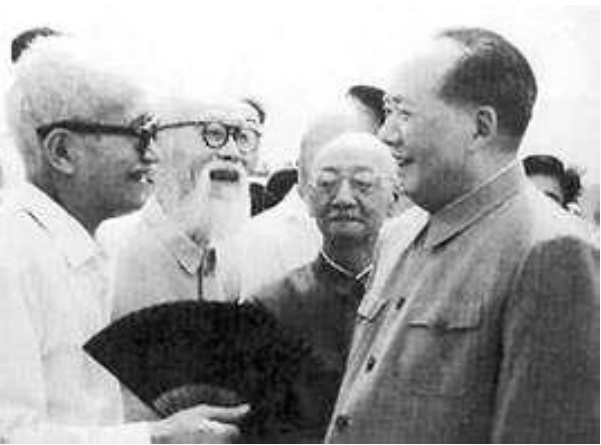
Chairman Mao and Zhang Shizhao are together
During the negotiations in Chongqing, it was not Liu Yazi who talked about "Spring and Snow in the Qinyuan" in the second comment, but Yu Youren, a famous leftist figure and book saint of the Kuomintang. Yu Youren and Mao Zedong have a poetic relationship. Yu Youren thought that we should have a deep talk with Chairman Mao about poetry, so as to be worthy of the earnest concern of Chairman Mao Zedong and Vice Chairman Zhou Enlai. Then, at noon during the negotiations in Chongqing, Yu Youren specially hosted a luncheon for Mao Zedong, Zhou Enlai and Wang Ruofei, and invited Zhang Zhizhong, Zhang Qun, Shao Lizi, Ding Weifen, Ye Chuchen and others to attend. Because Mao Zedong and Yu Youren, the sage of books, share the same interests and enjoy poetry, during the banquet, they murmured and talked about poetry. During the conversation, Yu Youren was full of praise for Mao Zedong’s "Spring and Snow in the Qinyuan", and the poem’s closing sentence "Count the romantic figures, but look at the present" was a quatrain, which was greatly appreciated and considered as the most beautiful sentence to inspire the younger generation. It was unprecedented, unprecedented and unparalleled. However, Chairman Mao said with great humility and humor: "How can it be worth the pen of the master’s’ Your Majesty asked me when I would recover the mountains and rivers’?"
Why did Chairman Mao make this statement? It turned out that in October 1941, during the Anti-Japanese War, Yu Youren visited the northwest. When he visited Genghis Khan’s mausoleum and the relics of the Western Expedition, he was poetically inspired and wrote a poem called "Yue Diao Tian Jing Sha", in which the whole word said, "Singing on the side of Xinglong Mountain, I once looked forward to invincible Jin Ge. After reading the testament and burning incense, the king asked me, when will the mountains and rivers be recovered? " After singing, Yu Youren and Mao Zedong couldn’t help laughing, and the whole room was full of laughter and happiness. Everyone congratulated Mao Zedong for making friends with poetry.
As Mao Zedong and Yu Youren are both great writers, it is not surprising that they improvise on the masterpieces of the ancients, but they can all recite each other’s poems, which shows that they have profound knowledge, memory is superman, and they are truly literary stars!
It is well known that Mao Zedong gave Liu Yazi a copy of "Spring and Snow in Qinyuan". At this time, Wu Zuguang, a famous playwright, served as the editor of the supplement "Western Night Tan" of Xinmin Evening Newspaper, a private newspaper in Chongqing. He first copied Mao Zedong’s lyrics from Huang Miaozi, while Huang Miaozi copied them from Wang Kunlun. There were some missing words in the manuscript, but he still understood the meaning of the lyrics. So, Wu Zuguang went to several places, even found a few people, put the copied books together, and finally got a complete work of "Spring and Snow in Qinyuan", which was immediately published in the supplement of Xinmin Evening News on November 14th. After the publication of the lyrics, it immediately caused a sensation in the mountain city, and at that time, it became a common practice and spread widely throughout the country.
On December 4, 1945, the Central Daily, the organ newspaper of the Kuomintang, was published in a big headline in the supplement. The Peace Supplement of the Kuomintang military Peace Daily (formerly known as Sweeping Newspaper) is full-page; Paul Yu Pin, the running dog of the U.S.-Chiang reactionaries and the leader of the Catholic reactionaries, published a batch of reactionary poems by means of false "readers’ contributions", distorting them wantonly and slandering them maliciously for no reason. Chiang Kai-shek directly ordered the Propaganda Department of the Kuomintang Central Committee to organize some literati and the Kuomintang literati who could write lyrics to write one or several lyrics of "Qinyuanchun" and carry out "crusade" in the name of singing. At the same time, select a poem that can surpass Mao Ci in artistic conception and momentum, and publish it in the name of the leader of the Kuomintang, so as to overwhelm Mao Zedong’s "Spring and Snow in Qinyuan".
Chiang Kai-shek also sent someone to Chen Bulei and said to him, "I think Mao Zedong’s ci has imperial thoughts. He wants to go back to the ancients and follow the example of Tang Zong and Song Zu and claim hegemony." And asked Chen Bulei: "You should quickly organize a group of people to write articles to criticize Mao Zedong’s’ Emperor Thought’ in the name of commenting on Mao Zedong’s poems, so as to let the people of the whole country know that Mao Zedong came to Chongqing not for peace talks, but for calling himself emperor."
Because of Chiang Kai-shek’s direct command, most of the more than 20 songs and works published in newspapers controlled by the Kuomintang contained malicious attacks and slanders from political parties. This great encirclement and suppression of counter-revolutionary culture is a historical joke of reactionary political culture led by Chiang Kai-shek and planned by the Propaganda Department of the Kuomintang Central Committee. The Kuomintang held a special black meeting for this purpose and assigned the main tasks to the Central Daily and Peace Daily. Because they are extremely reactionary in politics, although they started to be aggressive, after all, they were at their wits’ end and couldn’t come up with anything. On December 4, Central Daily News threw out two ugly and contemptuous works under the aliases of "Donglu Ci Poet" and "Yun Shi", and they were self-righteous. The Peace Daily, which was directly controlled by the Kuomintang Military Commission, served as Depth Charge, and Yi Junzuo, a shameless literati and design member of the third hall of the Political Department of the Kuomintang Military Commission, was a literary scholar. On December 4, 5, 10 and 13, and on January 3 and 25 of the following year, he published 15 reactionary poems and articles. However, Yi Junzuo’s "Qinyuanchun" just came out on December 4th and was immediately refuted by Objective magazine. He knew he wasn’t, and then "Spring in Puqin Garden" was really self-confessed, which was nothing more than "the gaffes of Wang Po".
The Kuomintang literati’s harmony words and poems and Mao’s ci "Qin Yuan Chun Xue" are simply worlds apart. How easy is it to shake a tree? "Spring and Snow in Qinyuan" is magnificent, flat and neat, catchy, beautiful and well-known! Even today, no one can compare it, which is a swan song of the ages! This is the political influence and historical significance of "Spring and Snow in Qinyuan".
(To be continued)
(Reference: Selected Works of Chongqing Literature and History, No.1)
Source: Sichuan Local Records Office
Text/Photo: Hu Pingyuan (special researcher of Chongqing Municipal People’s Government Literature and History Research Institute, member of Chongqing Communist Party History Society, member of Chongqing Writers Association, member of Chongqing Documentary Literature Society, and editor of "Oral History of Banan" in the Party History Research Office of Banan District Committee of Chongqing)