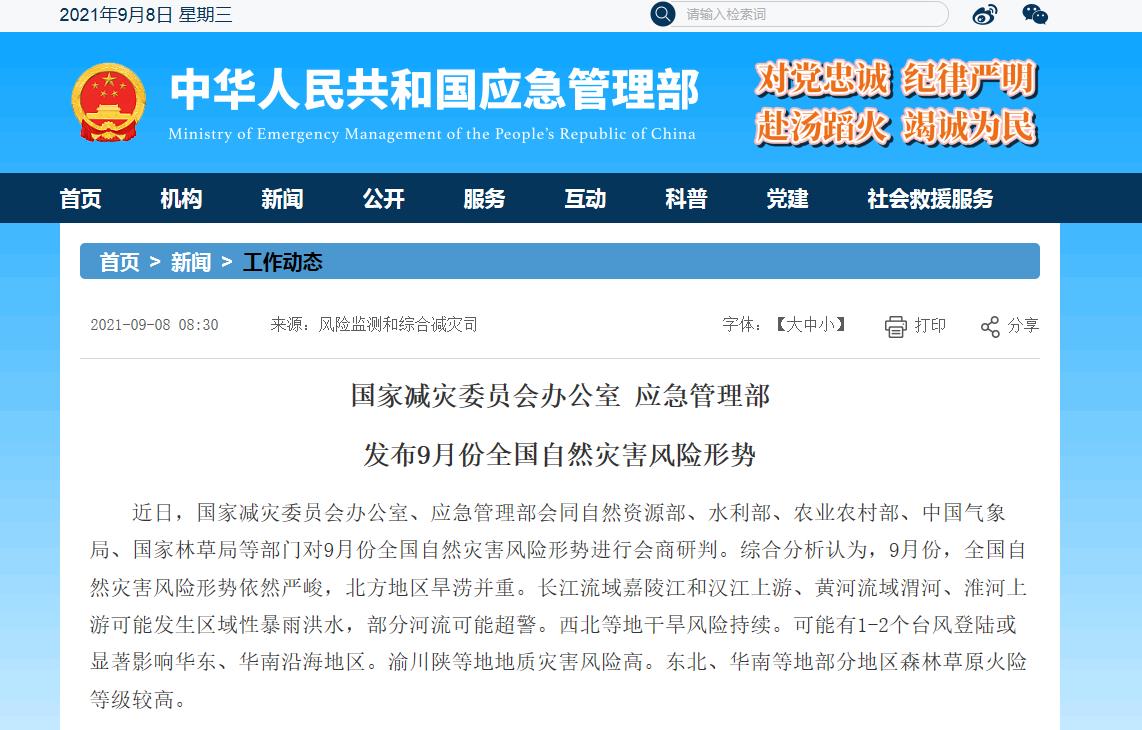
CCTV News:According to the website of the Emergency Management Department, recently, the Office of the National Disaster Reduction Committee and the Emergency Management Department, together with the Ministry of Natural Resources, Ministry of Water Resources, Ministry of Agriculture and Rural Affairs, China Meteorological Bureau, National Forestry and Grassland Administration and other departments, discussed and judged the national natural disaster risk situation in September. Comprehensive analysis shows that in September, the national natural disaster risk situation is still grim, and drought and flood are equally important in the northern region. Regional storms and floods may occur in the upper reaches of Jialing River and Hanjiang River in the Yangtze River basin, Weihe River and Huaihe River in the Yellow River basin, and some rivers may exceed the police. The drought risk in northwest China and other places continues. There may be 1-2 typhoons landing or significantly affecting the coastal areas of East China and South China. The risk of geological disasters in Chongqing, Sichuan and Shaanxi is high. The fire risk rating of forest and grassland in parts of Northeast China and South China is relatively high.
The risk of floods in many places in the north and south is high. It is estimated that the precipitation in the western part of Northeast China, eastern Inner Mongolia, northern North China, Huanghuai, Jianghuai, Jianghan, northeastern part of Southwest China, southeastern part of Northwest China and northern Xinjiang is more than normal, among which the precipitation in eastern Inner Mongolia, upper and middle reaches of Hanshui River, northeastern part of Southwest China and northern Xinjiang is more than 20%. Regional storms and floods may occur in the upper reaches of Jialing River and Hanjiang River in the Yangtze River basin, Weihe River and Huaihe River in the Yellow River basin, and some rivers may exceed the police. The above areas need to guard against disasters such as floods, flash floods and waterlogging in urban and rural areas caused by regional heavy precipitation, and autumn rains in Jianghan, the northeast of southwest China and the southeast of northwest China may cause autumn floods.
There may be 1-2 typhoons landing or affecting China. It is estimated that in September, there may be 4-5 typhoons in the northwest Pacific and South China Sea, of which 1-2 typhoons will land or significantly affect the coastal areas of East China and South China. There may be 1-2 disastrous typhoon storm surge processes in China’s coastal areas, 1 disastrous temperate storm surge process, and 3-4 disastrous wave processes of more than 4 meters in offshore waters.
The risk of disaster caused by strong convective weather is high. In August, strong convective weather in 103 counties in 12 provinces (autonomous regions and municipalities) caused wind and hail disasters, and crops in Xinjiang and other places were seriously affected. It is expected that strong convective weather will continue to occur frequently in September, accompanied by strong convective weather such as short-term heavy precipitation, thunderstorms and hail, which is likely to cause secondary disasters such as flash floods, short-term waterlogging, landslides and mudslides, and it is necessary to continue to prepare for emergency rescue and disaster relief.
Some areas such as southwest and northwest have high risk of geological disasters. Geological disasters are likely to occur in northeastern Chongqing, northeastern Sichuan and southwestern Shaanxi. The southern mountainous and hilly areas should strengthen the prevention of geological disasters such as landslides and mudslides caused by heavy precipitation; In the northwest loess area, it is necessary to prevent the collapse, landslide and debris flow at the edge of loess plateau; The Three Gorges reservoir area should guard against geological disasters during the fluctuation of water level.
Drought in northwest China and other places may continue or develop. Since July, the northwest loess plateau has been suffering from high temperature and little rain, and the drought has developed rapidly. The disasters are mainly concentrated in Shaanxi, Gansu, Ningxia and other provinces (regions). In September, the temperature in most parts of the country is close to the normal period to high, and the precipitation in western South China, southern Southwest China, southern Xizang, western Inner Mongolia, Hexi, Gansu and other places is 20-50% less, so the drought may continue or develop.
The forest fire risk rating in Northeast China and South China is relatively high. The fire risk rating of forest and grassland in eastern Jilin, eastern Heilongjiang, southern Fujian, southwestern Jiangxi, southern Hunan, Guangdong, Guangxi and other places is higher in some time periods. Inner Mongolia and Daxinganling region of Heilongjiang need to continue to guard against the risk of forest fire caused by lightning.