CCTV News:The third week of August (August 19th — August 25), various departments voiced their voices and a series of policies were released one after another. The editor sorts out the important measures focusing on people’s livelihood concerns in many fields, which are closely related to your life and mine? Understand in one article.
◆ Consumption:General Administration of Customs completely suspended the import of Japanese aquatic products.
On August 24th, the Japanese government officially started the Fukushima nuclear sewage discharge project. In order to prevent the risk of radioactive pollution on food safety caused by the discharge of nuclear contaminated water from Fukushima, Japan, and protect the health of consumers in China, the General Administration of Customs decided to completely suspend the import of aquatic products (including edible aquatic animals) originating in Japan from that day (inclusive).
◆ Supervision:The General Administration of Market Supervision strengthened the supervision of aquatic product food safety and salt price.
In response to Japan’s nuclear pollution discharged into the sea, the General Administration of Market Supervision has further strengthened food safety supervision, prohibited food producers and operators from purchasing, using aquatic products and processed foods originating in Japan, making meals or selling them, strengthened food safety sampling and monitoring of imported aquatic products sold in the market, and investigated and dealt with illegal acts in strict accordance with the law.
At the same time, the General Administration of Market Supervision has deployed all localities to strengthen the monitoring of salt prices, and strictly investigate illegal activities such as hoarding, fabricating and spreading price increase information, etc.
◆ Monitoring:The Ministry of Agriculture and Rural Affairs has stepped up the monitoring of nuclear pollution risks of marine aquatic products.
In response to Japan’s nuclear polluted water discharged into the sea, the relevant person in charge of the Ministry of Agriculture and Rural Affairs said that it will strictly follow the national standard for the restricted concentration of radioactive substances in aquatic products, increase the monitoring of nuclear pollution risks of marine aquatic products, and ensure the quality and safety of aquatic products. At the same time, pay close attention to the possible harm to China’s marine fisheries caused by the discharge of nuclear pollution water from Fukushima, Japan, and protect the healthy development of marine fisheries.
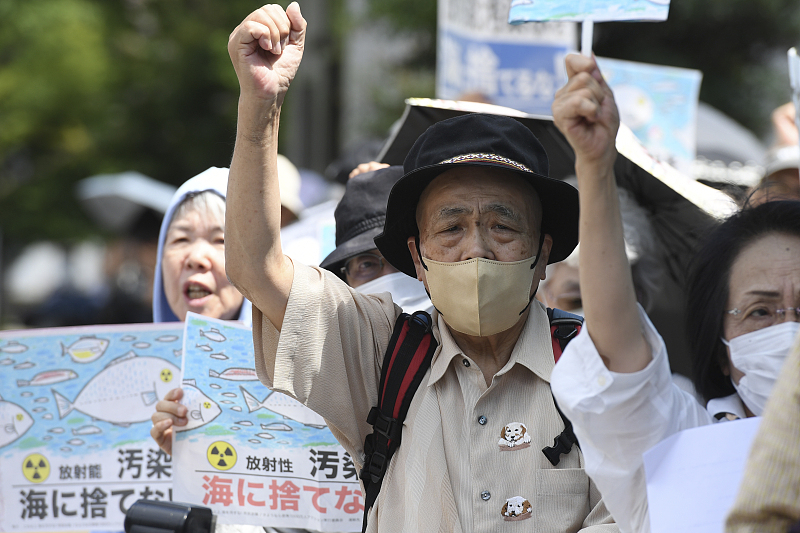
当地时间2023年8月25日,日本东京,人们聚集在日本首相办公室前,抗议从受损的福岛核电站排放经处理的核污染水。
◆ Life:China National Salt Group stated that 87% of the salt in China is well salt, and the reserves are sufficient.
Affected by the news that the nuclear polluted water from the Fukushima Daiichi nuclear power plant was discharged into the sea, there was a phenomenon of grabbing salt in Beijing, Shanghai and other places. China National Salt Group issued a statement on ensuring the supply of salt market, saying that at present, China’s salt product structure accounts for 87% of well salt, 10% of sea salt and 3% of lake salt, and the production of well salt and lake salt is not affected by nuclear pollution in Japan.
◆ 健康:Can eating iodized salt prevent nuclear radiation? Beijing CDC rumors
After Japan’s nuclear sewage was discharged into the sea, there were rumors that "iodized salt can prevent nuclear radiation". Beijing CDC clearly pointed out that this view is incorrect. The purpose of iodizing salt is to prevent and treat iodine deficiency disorders. In a nuclear pollution accident, radioactive iodine is mainly accumulated in the thyroid gland. In the early stage of the accident, it is necessary to take 100mg of "stable iodine" once, which is equivalent to taking 3-5kg of edible iodized salt once.
The Dietary Guidelines for China Residents (2022) clearly states that "adults should not consume more than 5g of salt every day". If excessive intake occurs, it will cause serious burden to various organs of the human body, induce or aggravate cardiovascular and cerebrovascular diseases and chronic nephropathy, and even cause dehydration and even death in severe cases.
◆ Travel:The price pressure line is raised, and the price of refined oil products is "five consecutive rises"
国家发展改革委消息,根据近期国际市场油价变化情况,自2023年8月23日24时起,国内汽、柴油价格每吨均提高55元。
今年6月份以来,国内成品油最高零售限价历经连续五次上涨。据测算,家用轿车、小型私家车加满一箱92号汽油将较之前多花2-3元。
◆ 健康:新冠病毒变异株EG.5出现,国家疾控局回应热点关切
世界卫生组织宣布,将新冠病毒变异株EG.5列为“需要留意的”变异株。加之身边感冒的人增多,民间出现对“三阳”的讨论,国家疾控局对此回应称,全球风险等级为低风险,该毒株虽在国内有流行趋势,不过已建立的奥密克戎XBB系列变异株人群免疫力对EG.5变异株仍具免疫保护作用,短期内不会发生规模性疫情。
◆ 住房:换房退税优惠政策延续至2025年
8月25日财政部等3部门联合发布公告,决定自2024年1月1日至2025年12月31日,对出售自有住房并在现住房出售后1年内在市场重新购买住房的纳税人,对其出售现住房已缴纳的个人所得税予以退税优惠。