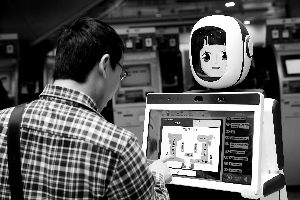
Recently, the First Affiliated Hospital of Zhejiang University introduced a medical intelligent robot named "Tang Bao". Xinhua news agency
Promoting machine substitution in many places has attracted attention.
May Day, a holiday for laborers. At the same time, a kind of "robot worker" is increasingly attracting social attention. Official website, Ministry of Industry and Information Technology, shows that Zhejiang takes the lead in promoting machine substitution, and plans to implement 5,000 machine substitution projects every year for more than four years from 2013, realizing 500 billion yuan of investment in machine substitution. Lingyun, deputy director of Zhejiang Economic and Information Committee, said that by 2015, the project had reduced the number of ordinary workers by nearly 2 million; Anhui is stepping up efforts to promote "‘ Machine substitution ’ Ten thousand projects "; Guangdong, Shandong and other places have vigorously promoted "machine substitution" in their own industrial fields with comparative advantages, and many manual jobs have been replaced by robot labor.
Robots are more suitable
Industrial manufacturing service field
Intelligent automobile fire control and rescue
medical care
High-end employment opportunities
Industrial data scientist robot coordinator
Industrial engineer simulation expert
Design of Supply Chain Coordination Post System
Information technology 3D aided design
Machine substitution blooms everywhere
Experts in the industry said that at present, China’s robot manufacturing technology is becoming more and more mature, and the reform needs to promote economic restructuring, high labor costs and difficulties in employment have jointly promoted the expectations of all walks of life for robot labor.
In the workshop of Shenzhen Lei Bai Science and Technology, the protagonist of the production line is not rows of workers, but rows of flexible turnover mechanical arms. Through the research and development of intelligent automation system, the number of direct production employees in Lei Bai Science and Technology has been reduced from more than 3,200 at the peak more than ten years ago to more than 800 now, saving a lot of expenses every year.
It is reported that since 2005, Lei Bai has suffered from "labor shortage" and the labor cost has risen. In 2011, Lei Bai bought 75 industrial robots at one go, and the labor cost plummeted. "Take keyboard assembly as an example. Now on a production line, five workers can complete the workload of the previous 100 people by managing robots. " Liu Ciping, manager of Lei Bai Robot Operation Management Department, said.
According to the data of Dongguan Economic and Information Bureau, from September 2014 to October 2016, a total of 1,485 special fund projects for "machine substitution" in Dongguan were declared, which is expected to reduce 87,000 workers.
Robots greatly reduce the labor costs of enterprises. Headquartered in Shaoxing, Zhejiang Province, Sanlux Company has saved more than 10 million yuan in labor costs, accounting for about 7% of the company’s net profit in that year.
Which jobs are more likely to be robbed?
The reporter learned that the scope of the current "machine substitution" is not limited to industrial manufacturing, and manual jobs in some service fields have begun to be quietly replaced by robot workers.
Yuan Hui, the founder and chairman of Xiaoyi Robot, told reporters that in 2015, China Construction Bank used customer service robots in call centers, which replaced a large number of employees that year. "There are still many banks, operators, e-commerce and even local governments that are beginning to use robots." Yuan Hui said.
Wang Tianmiao, dean of the Intelligent Manufacturing Research Institute of Beihang University, believes that robotics will be widely used in industrial manufacturing, service fields, as well as smart cars and drones.
Wu Lihua, business director of Shandong Linyi Shentong, said that in order to improve efficiency and avoid violent sorting, at present, Linyi Shentong is equipped with 320 intelligent sorting robots, which can handle 18,000 packages within 5 kg per hour, with an accuracy rate of 100%. The manpower required for the same workload was reduced from 150 to 30, and the number of posts was reduced by as much as 80%.
Jiangsu Changzhou Fire Phoenix perpetual fire fighting robot company launched a fire fighting robot named "Fire Phoenix". Ren Qubo, general manager of the company, said that this robot can not only resist high temperature, but also detect toxic gas, which can replace firefighters to enter high-risk fire, explosion and toxic environment and perform tasks such as closing valves, thus reducing the probability of secondary explosion at the accident site.
Dr Qu Daokui, chairman of China Robot Industry Alliance, said that service robots have a broad market and broad prospects in China. "For example, we are doing clinical experiments of intelligent nursing equipment, which can detect various physiological parameters." Qu Daokui emphasized that "in the future, robots can have great potential in public services such as fire fighting, rescue, guarding and medical care."
Wang Guiqiang, a researcher at the Equipment Industry Department of Shandong Economic and Information Committee, believes that the rise of artificial intelligence may cause some low-skilled workers to lose their jobs. But some experts believe that the application of robots will create more high-end employment opportunities. This may include the needs of industrial data scientists, robot coordinators, industrial engineers, simulation experts, supply chain coordination positions, system design, information technology, 3D CAD, field service engineers, sales and service personnel. It is worth noting that these new jobs are highly professional.
How to face machine substitution?
Most experts believe that although robots have a certain impact on manual jobs, there is absolutely no need to be overly nervous.
Wang Yamin, who works for Guangdong Changying Precision Technology Co., Ltd., told reporters that although her job was once replaced by a robot, after two months of training, she has been re-employed, promoted from a general worker to a technician student, and even increased her salary. Luo Weiqiang, assistant to the general manager of the company, said that despite the vigorous promotion of "machine substitution", most employees can be digested within the company and re-employed after job-transfer training.
"The purpose of human beings inventing robots was to replace people at first, and then to serve people, and to expand people in the future." Academician Ding Han, Dean of the School of Mechanical Science and Engineering, Huazhong University of Science and Technology, said, "At present, most industrial robots work in some structured environments, and their online sensing ability is relatively poor. At present, service robots can only complete some simple tasks. As for special robots, it is necessary to complete specific tasks through manual remote control. " According to Xinhua News Agency
■ Related news
Smart economy makes ordinary work taller.
Big Data, Cloud Computing, Network Economy, Artificial Intelligence … … In recent years, with the popularity of these new economic terms, smart economy has become an important development direction of China’s economic transformation and upgrading, which not only greatly improves the production efficiency and the scientific and technological content of products, but also makes profound changes in the working methods of many industries. In the past, some heavy "hard work" that ordinary workers engaged in is becoming more and more simple and "high-level".
Express brother saves time and effort
In Yunda Shanghai Distribution Center, a piece of courier flows from the fully automatic sorting assembly line to its respective sorting grid and slips into the bag. According to reports, the automatic sorting assembly line can handle more than 20,000 tickets per hour, equipped with more than 10 parts supply stations and nearly 300 grids.
Shi Renyu, who has worked in Yunda Shanghai Distribution Center for 10 years, really felt the amazing power of "black technology" in China logistics industry in recent years. He said that in the past, sorting by artificial memory was slow and error-prone. Now, it relies on big data and robots to sort, which greatly reduces the workload and has high accuracy.
In 2016, China’s express delivery business volume was about 31.3 billion pieces, which has firmly locked in the status of "the largest express delivery country"; According to incomplete statistics, the number of couriers in China has exceeded 2 million.
Electric workers don’t have to climb high.
Peng Xingxing is a line inspector in the transmission inspection room of State Grid Changchun Power Supply Company. His daily work is to walk among all 66,000-volt high-voltage towers in Changchun and explore the towers with binoculars to find hidden dangers. "What I am most afraid of is that some faults need to climb the tower to check." Peng Xingxing said that the weather is getting warmer now, and it is a "painful" thing to climb the tower in winter. "Although there are protective devices to ensure safety, sometimes my heart is still ‘ Offend ’ 。”
Today, Peng Xingxing doesn’t have to "fight" anymore. "This is the company’s configuration for line inspectors, which can replace manual ladder climbing." Peng Xingxing and his partner each held a remote control handle, and the partner operated the drone to take off. Peng Xingxing operated the camera through the remote control and carefully explored every position on the tower. In the past, it took about an hour to manually climb the tower, but now the drone flies from the ground to the top of the tower and then returns. The whole process takes less than 20 minutes.
Laborers should upgrade their skills.
Yang Jianhua, executive director of the Chinese Society of Social Sciences and president of the Zhejiang Society of Social Sciences, said that from the agricultural age to the industrial age, and then to the current intelligent age, there is a path of self-liberation of workers step by step. In the past, higher economic value was mainly created by overworked and physical labor, but in the era of smart economy, the skills, brains and creativity of workers are particularly important. Yang Jianhua pointed out that at present, China’s smart economy is developing at a high speed, and it also overlaps with the supply-side structural reform, and it has emerged in many industries. At the same time of "reducing the burden", the smart economy will inevitably require workers to constantly improve their skills in order to control artificial intelligence and adapt to the new economic form. According to Xinhua News Agency