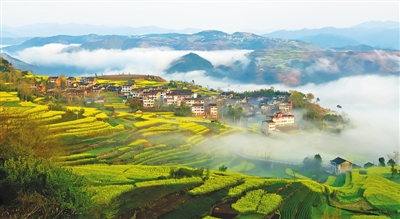
Rape flower in Sangzhou, Ninghai. Information picture
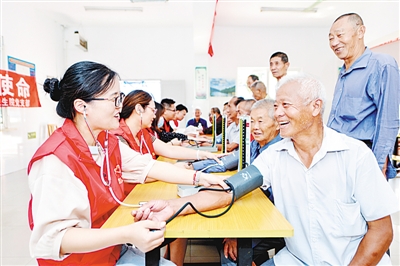
Volunteers from the Medical Community Group of Changxing County Hospital of Traditional Chinese Medicine in Huzhou measured blood pressure for the elderly free of charge. Information picture
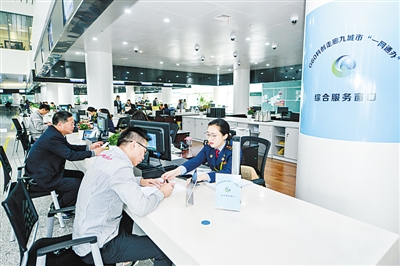
At the general service window of G60 Science and Technology Corridor of Changxing Government Service Center, citizens are applying for the business license of Shanghai Company. Information picture
editorial comment/note
Governing the country is regular, and benefiting the people is the foundation. In 2004, Zhejiang took the lead in issuing "Several Opinions on Establishing and Perfecting a Long-term Mechanism for Doing Practical Things for the People", focusing on ten key areas, such as social security, ecological environment, science, education and culture, and social stability, and clearly accelerating the establishment and improvement of five working mechanisms: reflecting people’s feelings, democratic decision-making, responsibility implementation, investment guarantee and supervision and evaluation. Since then, the long-term mechanism of doing practical things for the people has taken root in Zhejiang, and the upsurge of doing practical things for the people has stirred up in Zhijiang. In the past 15 years, Zhejiang has put the practical work for the people into the overall layout of the "five in one" of Socialism with Chinese characteristics’s cause, constantly improved the holistic and systematic response mechanism to the demands of the masses, innovated the participatory social governance model of "participation of the whole people and social coordination", and continuously promoted the modernization of governance system and governance capacity. The practice in Zhejiang is of great practical significance for studying and implementing the spirit of the Fourth Plenary Session of the 19th CPC Central Committee, upholding and improving the people’s livelihood security system of coordinating urban and rural areas, and upholding and improving the social governance system of co-construction, co-governance and sharing. Recently, Guangming Daily’s research team went to Changxing, Wenling, Luqiao, Ninghai and other places in Zhejiang Province, and had face-to-face communication with grassroots cadres and masses through field visits, centralized discussions and individual interviews, and conducted in-depth research on Zhejiang’s long-term mechanism of doing practical things for the people.
In late autumn in Zhejiang, the layers of forests are dyed and colorful. From the source of Qianjiang River to the coast of the East China Sea, from the south bank of Taihu Lake to the bank of Oujiang River, everywhere, the scenery is fresh and beautiful, and it exudes the unique charm of being pleasant, livable and suitable for business.
Fifteen years ago, it was also a golden autumn, and a long-term mechanism for doing practical things for the people began to be built in Zhijiang. The participatory social governance of "people’s issues", the financial investment mainly in people’s livelihood, the cultural nourishment of goodness and beauty, and the ecological construction of "Lucid waters and lush mountains are invaluable assets" were deepened day by day. Fifteen years later, walking in the cities and villages of Zhejiang, the research team deeply felt that from provinces and cities to counties and townships, from individuals to society, from basic public services to global development, Zhejiang has been playing a strong voice of the times with people as the center, and the long-term mechanism of doing practical things for the people with distinctive characteristics has entered the track of standardization, institutionalization and regularization.
1, "people call me" to activate the enthusiasm of the masses to participate.
To promote the modernization of the governance system and governance capacity, we must ask for the people, ask for the people, and rely on the people closely. What kind of practical mechanism for the people can make the people participate in decision-making in the whole process?
In front of a five-story building with white walls and tiles in Liyang Town, Ninghai County, Ye Zhenfang, a representative of the county people’s congress, carefully inspected the construction progress of the home care service center in this town, while clicking on the mobile phone "Ninghai Ticket Decision System" App to upload photos of field trips. "Precise Rehabilitation Service Project for the Disabled", "Relocation Project of Qiantong Town Health Center" and "Women and Children Activity Center Project" … … Sliding the screen of the mobile phone, these "key things" that are gathered from public opinions are presented in the list of "Ninghai County People’s Congress deputies voted for people’s livelihood practical projects in 2019", and NPC deputies can track and supervise the project progress in real time.
In Ninghai, the people’s livelihood project is no longer decided by the government, but voted by the deputies to the National People’s Congress. The implementation process is supervised by the deputies, and the construction results are evaluated by the deputies. This kind of "people order, deputies vote, and the government cooks" people’s livelihood project has been implemented for ten years.
It is with the support and supervision of the deputies that what the masses think can be done quickly and well. Liyang Town, the birthplace of the voting system, is the transportation hub in the east of Ninghai. As early as 2006, it planned to renovate the passenger station to solve the traffic ills, but it had to be shelved for a long time because a few villagers did not cooperate. However, the "transformation of passenger station" was selected as the first livelihood project in the process of deciding the ticket system in 2008, and the signing of the requisition and relocation was completed within two months. "This is a project selected on behalf of the masses and cannot be in our hands." Xu Peifei, a former deputy to the National People’s Congress, told the research team when he introduced the scene of the town people’s congress deputies doing villagers’ work in groups and from house to house.
From "being the master for the people" to "being the master by the people", from "wishful thinking" to "your feelings and my wishes", the work pattern of "people calling me to respond" and "the masses asking questions" has gradually taken shape in Zhejiang. Nowadays, the voting system for deputies to the people’s livelihood projects has achieved full coverage at the county and township levels in Zhejiang.
What kind of practical mechanism for the people can widely mobilize forces and reflect the demands of the masses in many ways?
More than 50 years ago, Zhuji created the famous "Maple Bridge Experience" in China, and now it is upgraded to "Maple Bridge Experience" — — The normalized "5+N" operation of general grid with full-time grid staff and social forces including lawyers and rural sages has been implemented in many places in Zhejiang.
In Hengjie Town, luqiao district City, Taizhou City, Luo Pei, a grid worker, is investigating potential safety hazards in the printing plant of Huanzhen South Road. While taking photos, he reports the potential safety hazards through the "Ping An Tong" App. In addition to the problems found by grid workers in the streets and villages, the integrated information command room at the other end of the link "Ping An Tong" is also making data "running errands" all the time: multi-department information such as safety supervision, fire protection and food safety is accepted and accepted. The survey shows that in Luqiao, more than 90% of social problems and social contradictions have been resolved at the grassroots level, and the people’s sense of security and satisfaction have been significantly improved.
From the collection of public sentiment information to the propaganda of policies and regulations, from the service of grid residents to the mediation of contradictions and disputes … … Nowadays, many post-80s full-time grid workers like Luo Pei have become "all-rounders" working in the "responsibility field".
“‘ General practice grid ’ Pass ‘ Handle affairs at the source and do things on the spot ’ , from ‘ Small public security ’ To ‘ Great peace ’ The transformation. " Mou Aoye, deputy secretary of the Luqiao District Committee and secretary of the Political and Legal Committee, said.
What kind of practical mechanism for the people can achieve deliberative democracy?
"How to allocate resettlement houses after relocation?" "What are the compensation standards?" "Is there a place for ordinary people to move to the new area?" At the democratic forum on the relocation of the whole village in Daxi Town, Wenling, Taizhou, the research team observed a "hot" folk "focus interview". Public toilet reform, garbage classification, school location … … Now, Wenling holds more than 1,800 democratic talks every year on average, which has become a "golden business card" for Wenling to deepen its reform.
"Through the extensive and orderly participation of the masses in the decision-making and management of social public affairs, democratic talks have solved many people’s livelihood issues of common concern to the government and the masses, and solved contradictions and disputes from the source." As the founder of democratic talk, Chen Yimin, director of Wenling Democratic Talk Office, told the research team.
Through big data analysis, the mobile phone software "Longyoutong", which keeps abreast of people’s voices, can be called "36 small and micro powers in Ninghai" … … From the reflection of people’s feelings to democratic decision-making, from the implementation of responsibilities to supervision and evaluation, a long-term mechanism of people’s livelihood with participatory social governance as the main feature has enabled the government to accurately grasp the needs of people’s livelihood, formed a benign interaction between the government and the people, and constructed a new pattern of social governance with co-construction, co-governance and sharing.
2. "People’s livelihood finance" solves the public service problem
How do the fruits of economic development translate into people’s well-being? In Zhejiang, the long-term mechanism of doing practical things for the people, focusing on promoting the equalization of basic public services, has been continuously deepened.
"I didn’t expect to get the construction permit the next day, and started work more than 20 days earlier than expected." Zhou Jifeng, head of the workshop project of Zhejiang Wangjin Nonwovens Co., Ltd., told the research team happily. In order to solve the problems of long time-consuming and unclear responsibilities in drawing review of infrastructure projects, Changxing County, Zhejiang Province took the lead in implementing the "exemption list" system in the province by optimizing the scope of construction drawing review. "In the past, we had to wait for the drawings to pass the examination before we could apply for the construction permit. Now we cancel the pre-approval examination of the construction drawings of construction projects and implement the self-examination commitment system, which improves the efficiency and reduces the burden for enterprises." Jiang weihong, deputy director of Changxing county government affairs management office, introduced.
"One Netcom Office", "Packaging and Approval, Integrated Services" and "Open 24 Hours" … … In recent years, Zhejiang has continuously extended the reform of "running at most once" and focused its government resources on improving people’s quality of life, compulsory education and social security. At the same time, government services are sinking, and they are stationed in community and rural convenience service centers. At present, more than 90% of the items in cities and counties in Zhejiang Province have achieved "running at most once", and the satisfaction rate in 2018 reached 96.5%.
In Ginkgo Forest, Xiaopu Town, Changxing, the research team saw that colorful thousand acres of flowers and antique old streets with white walls and gray tiles rejuvenated Badu Village, which was once left out, and attracted tourists from all directions.
"The glass plank road is the first project signed by the five village economic associations in Badu Scenic Area, with an estimated annual income of about 3 million yuan." Jin Fei, deputy mayor of Xiaopu Town, introduced that at the beginning of this year, five villages of Xiaopu Town, namely, Xiaopu, Fangyi, Fangyan, Panlinan and Datuokou, set up an economic joint-stock company to explore the collective development mode by means of village integration.
Improve financing loans, establish poverty alleviation funds, and reduce taxes and fees … … Looking at Zhejiang, there are frequent new tricks in rural revitalization, which have brought tangible real money to the people.
The research team saw in the Jiapu Town Health Center in Changxing that telemedicine centers such as electrocardiogram and imaging solved the problem of experts’ difficulty in making appointments. Sharing electronic health records without film projects has saved more than 35 million yuan in medical expenses for county people; The contract service of family doctors has guaranteed the health of chronic patients and the elderly. At present, the rate of seeing a doctor in Changxing county is 90%, and the satisfaction of patients evaluated by third parties is 92%. The pattern of "minor illness in the township, serious illness in the county, rehabilitation back to the township" has gradually taken shape.
It is understood that since 2003, Hangzhou has established a working mechanism of "breaking seven difficulties" for seven difficult problems, such as "difficulties in finding jobs, going to school and seeing a doctor", and incorporated them into government performance management. By leveraging commercial insurance with government funds, Ningbo has successively launched 165 insurance innovation projects, including comprehensive housing insurance for urban residents, and built a risk protection network closely related to people’s lives.
From infrastructure to health care, from poverty alleviation and development to employment and reemployment … … The foothold of doing practical things for the people is more on specific "small things" such as daily necessities, safety and warmth, which are closely related to the people. The research team learned that for 15 consecutive years, Zhejiang insisted on spending more than two-thirds of the province’s fiscal expenditure increase on people’s livelihood. In 2018, there were 126 provincial-level livelihood projects, with a cumulative livelihood expenditure of 4,414.8 billion yuan, 9.5 times that of 2004.
3. Culture benefits the people and makes the people "have something to send"
Not only let the people "have a place to live", but also let the people "have something to send." In Zhejiang, benefiting the people through culture has become an important aspect of doing practical things for the people.
"Ten thousand mu of Myrica rubra, a beautiful village, the ancient rhyme of wuyue originated from Liuchang … …” In the land of Zhijiang, the tall and solemn cultural auditorium always shows the new landmark of Zhejiang cultural spirit. In the Cultural Auditorium of Fuziling Village, Jiapu Town, Changxing, 61-year-old resident Zhang Yingfu is practicing opera: "We old opera fans who love opera often come here to sing and get addicted." In addition to singing operas, there are photography teams, painting and calligraphy teams, waist drum teams and so on. No matter the elderly, children or women, they can find activities suitable for them in the cultural auditorium. Nowadays, this cultural service complex, which integrates traditional folk customs and modern culture, integrates entertainment, ideological and moral construction and knowledge popularization, has become the most happy place for Zhejiang people to go.
Menu-style customization such as "cultural customization", "scouring culture" and "you order me to perform" is a characteristic innovation of Zhejiang culture benefiting the people. Since the construction of rural cultural auditorium was included in the "Ten Practical Things" to be done in Zhejiang in 2013, the province has established a "big menu system" by coordinating all forces, innovatively launched a docking platform for supply and demand of cultural services, and regularly distributed various cultural activities such as movies, calligraphy and painting, books and intangible performances, which not only launched free products from government departments, but also provided market-oriented paid products, which stimulated the enthusiasm of the masses to participate. For example, the cultural auditorium in Huilong Village, Yinzhou, Ningbo introduced the market-oriented operation of professional institutions, and the annual visits exceeded 30,000 times.
By the end of July this year, 12,826 cultural auditoriums had been built in Zhejiang, and the comprehensive cultural stations and village-level cultural activity rooms in the province had achieved full coverage.
"Only one banquet will be held, with no more than 40 tables for both parties, no more than 100 yuan for the unit price of drinks, no more than 1,000 yuan for a single table and no more than 100,000 yuan for the betrothal gift." In the bulletin board of villagers in Macheyu, Daxi Town, Wenling, an activity called "100 million" has attracted the attention of the research group.
"A few years ago, the number of banquets in our village reached thousands a year, and the cost of human exchanges was as high as 30,000 to 40,000 yuan, which seriously affected the quality of life." Xie Jizhi, a villager in the village, told the reporter, "Now the village has launched ‘ Civilized family banquet hall ’ Specially hired a gold medal chef to help us cook, saving a lot of money. " Xie Jizhi also took the lead in joining the volunteer service team to help villagers do ideological work.
The "rural civilization integral system" quantifies the intangible civilization morality, and the "most beautiful family style" advocates that all families promote virtues and every household teaches them … … Throughout Zhejiang, traditional culture is used to conserve mainstream values, cultivate virtues and good deeds, and innovate social governance. The Wuyue culture, which has been flowing for thousands of years, continues to nourish the spiritual world of Zhejiang people, and the project of benefiting the people with culture as the carrier of civilized practice in the new era continues to penetrate into cities and villages.
4. "Green water and green mountains" have become the source of happiness for the people.
The expectations of ordinary people from "hunger for food and clothing" to "hunger for environmental protection" and from "survival" to "ecology" have strengthened Zhejiang’s confidence and determination to solve ecological and environmental problems as the focus of people’s livelihood work.
Changxing, with water as its pulse, is surrounded by Taihu Lake in the east, wetlands in the abdomen and Miaomiao River and Lake water, which is soft and full of aura. But at the end of the 20th century, every household’s water-jet looms not only created economic benefits, but also caused river water pollution. "The original farming methods are extensive, and there are many small workshops. The water flowing out of our town is ‘ Milk ’ Shape, stinking. " Qian Xihua, a member of the Party Committee of Jiapu Town, told the research team that the town has successively carried out special actions to control water pollution, blocked 250 sewage outlets, banned 900 water pipes from fresh water pumps of water sprayers, and completed a series of water control projects such as dredging the water system and opening the broken river.
As early as 2003, Changxing took the lead in exploring the implementation of the "river length system" in the country. Up to now, 547 rivers in the county have been included in the "river length system" management, with 498 river lengths and 101 lake lengths at all levels, and the performance of river and lake lengths has been included in the comprehensive assessment. After years of improvement, Changxing has already realized the transition from "river length system" to "river length control", and the relevant experience has been popularized throughout the country.
Walking into Nanling Village, Sangzhou Town, Ninghai County, the houses built of bricks and stones are strewn at random according to the mountain situation. The terraces have different shades of Gesanghua flowers, and the bluestone paths in the village are winding and secluded, dotted with unique homestays. The boutique homestay set up by the villagers at home has revitalized the once-sleeping "hollow village".
"A few years ago, due to inconvenient transportation and backward facilities, young people in the village went out to work." Ge Jianbiao, secretary of the Party Committee of Sangzhou Town, said. The "beautiful transformation" of the village benefited from the "demonstration of thousands of villages and renovation of thousands of villages" project initiated by Zhejiang in 2003, and Nanling Village became one of the demonstration villages. Demolition of dangerous houses, hardening of roads, cleaning up wastes, regulation of rivers, construction of ecological public toilets and village greening … … Yaoyao, a post-80s designer, saw the increasingly beautiful environment in his hometown and came up with the idea of transforming his ancestral home into a rural homestay. Retain the old beams, old floor tiles and door panels, and the "dilapidated old house" will become a "beautiful old house" inspired by yaoyao, and become the punching place for "online celebrity".
Such a "beautiful economy" is becoming more and more common in Ninghai County. Since the strategy of "Grand Scenic Area" was put forward in 2011, the county has allocated 80 million yuan each year to carry out environmental improvement and develop green ecology and fine landscape construction. As of September this year, the turnover of 386 homestays reached 250 million yuan, and the total income of tourism economy was 13.67 billion yuan.
Since 2003, the project of "Demonstrating Thousands of Villages and Renovating Ten Thousand Villages" has won the United Nations "Guardian of the Earth" award, and Zhejiang’s achievements in ecological civilization construction have been internationally recognized. In recent years, Zhejiang has continuously improved the urban and rural living environment, and the quality of the ecological environment has been continuously improved. The assessment of "Ten Water Articles" and "Ten Gas Articles" is excellent, and the water quality of the inferior V sections has been completely eliminated. The sky is bluer, the mountains are greener and the water is clearer. The "Ten Thousand Projects" have made thousands of picturesque "beautiful countryside".
5. Reflections on Zhejiang’s long-term mechanism of doing practical things for the people.
Strengthen and improve national governance with people as the center. China’s national system and national governance system have the obvious advantages of "adhering to the people-centered development thought, constantly safeguarding and improving people’s livelihood, enhancing people’s well-being and taking the road of common prosperity". To promote the modernization of the governance system and governance capacity, we must ask for the people, ask for the people, and rely on the people closely. Zhejiang has always adhered to the "people-oriented" policy concept, formed a "people order" service model, constantly satisfied the people’s longing for a better life, and practiced and developed the "people-centered" development thought from different dimensions.
Take the long-term mechanism of doing practical things for the people as a pioneering attempt to promote the modernization of governance system and governance capacity. The Fourth Plenary Session of the 19th CPC Central Committee clearly stated that it is necessary to build a community of social governance in which everyone is responsible, everyone is responsible and everyone enjoys it. Whether it is the "Maple Bridge Experience", the National People’s Congress Deputies’ Voting System, Democratic Talks, or the "Three Governance Integration", Zhejiang, as the birthplace of many governance experiences in contemporary China, not only pays attention to the system and mechanism design, but also pays attention to the improvement of cadres’ thinking and ability, and has made a two-pronged approach to the governance system and ability, contributing to the modernization of the governance system and ability.
So that the people and the people can be the starting point and the end result of the reform. We will do what the masses think. In order to do practical things for the people, Zhejiang insists on starting with the "key little things" that affect the people’s production and life, thinking about government reform from the perspective of the masses, setting reform goals with the needs of the masses, and establishing reform standards with the feelings of the masses, so as to continuously enhance the people’s sense of acquisition, happiness and security. And "people’s satisfaction" has also become an important criterion to measure the effect of reform. In 2018, how did Zhejiang Province "do things about people’s livelihood — — You have the final say "activity, let the people be examiners and tell their true feelings, and the favorable rate of the masses reached 99.48%.
Strong institutional guarantee is the key to play a role in the long-term mechanism of private affairs. In the past 15 years, Zhejiang has continuously innovated and improved the long-term mechanism of doing practical things for the people, and built an institutional mechanism with multi-participation, horizontal to the side and up and down, and vertical to the end. The so-called horizontal is to implement the joint efforts of party Committee leaders, mass proposals, CPPCC deliberations, NPC deliberations, and government handling; The so-called vertical refers to the implementation of the road map with the main body gradually expanding from the provincial government to cities, counties and towns, top-down, responsibility to people and clear progress. Through the continuous improvement of the system, the beautiful blueprint of social governance modernization has been turned into tangible benefits for the people step by step.
(Author: Guangming Daily Research Group, members of the research group: Zhang Biyong, Lu Jian, Yan Hongfeng, Ceng Yi, Bai Xuelei, Lan Yani)